The writer mentions the most important difference just in passing, and he leaves the false impression that, at least for certain groups of Americans, the US system is similar to this or that country's system. I beg to differ.
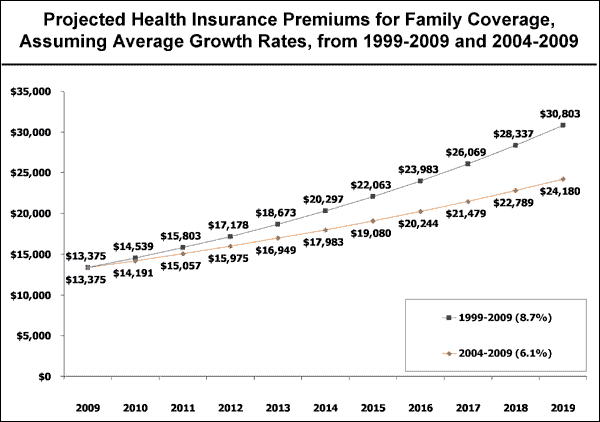
By far the most important difference is the fact that in the US, private insurance companies are allowed to extract huge profits (and to pay huge executive salaries) from a captive market's premium payments. Incidentally, in a bizarre and very obnoxious irony, current US proposals call for making the already captive market even more captive, via the so-called “mandate,” which intelligent people and most well educated economists know is actually a tax pig with lipstick on it.
The big profits and obscene executive compensation of private health insurance companies are the head of the snake, if you will. If you, as all reputable countries have done, strictly enforce a non-profit status for private health insurance companies, you can then go on to choose amongst a wide variety of health delivery configurations, which might include, if you insist, private (non-profit) health insurance companies.
If on the other hand you insist on allowing profit for private health insurance companies, you are doomed to have a failed health system and eventually a failed economy regardless of other choices you make. There is no in-between position regarding allowing profits for the “third party” health insurance companies. You either allow them or you don't. And then your system is either an automatic failure or a likely success based on that decision.
So let's be clear: there is not even one group of Americans who have a system quite similar to a reputable system existing elsewhere.
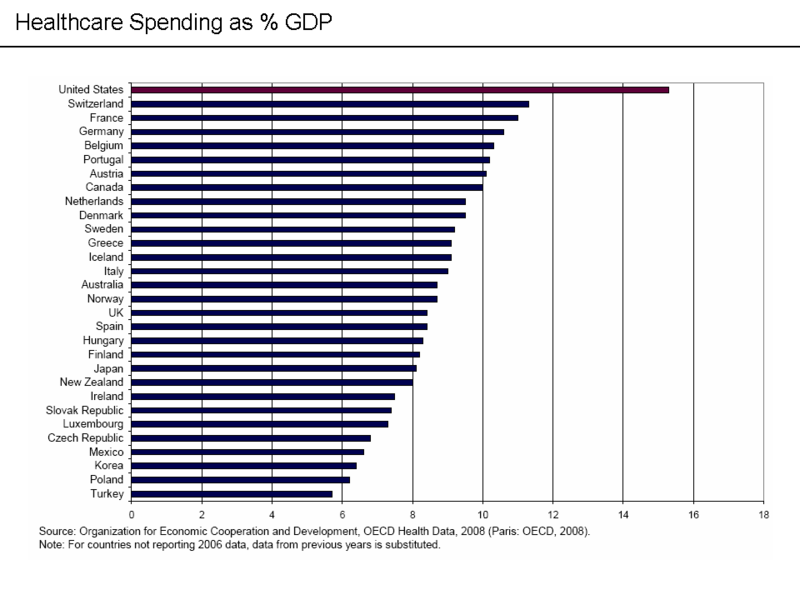
Even Americans who avoid direct exposure to the damage caused by private insurance company greed get hammered indirectly. For example, even veterans (who use the completely government-run veteran's administration health care system) are stuck with care limitations such as excessive waiting and denials of needed care via, for example, mistaken rulings that the problem is not “service-related”. These health care shortcomings and limitations are caused by a too high cost structure for the care itself. Because along with the sky high health insurance cost, the cost of the care itself is also far higher in the US than it is in the other countries.
This is so for several reasons, most notably the fact that there is no government regulation to contain costs as there is everywhere else, and also due to the overall grossly greater inequality of incomes in the US as compared with the inequality levels in the other countries.
Specifically for example, specialty doctors in the US make incomes that can easily be double, triple, maybe even quadruple or quintuple what the very same doctors are payed in all of the reputable countries. Hell, the "star surgeons" at the top of the heap might get 10 times what a similar European doctor would be payed, for all we know. (And we don't exactly know, do we, but we do know that US pay is ridiculously high at the high end, and ridiculously low for the masses.) Doctors should not be payed the way top NBA basketball players are.
In summary, there are two completely required beginning building blocks for a successful health care system. If you don't start with these, you won't be finishing with a successful system:
(1) Profit for all basic, fundamental and standard health insurance is strictly disallowed for any private companies that are allowed to provide that insurance. What basic, standard coverage is has to be carefully and in detail defined by health experts under Government supervision.
(2)The Government MUST provide a workable set of regulations that prevent the cost of the health care itself from rising at rates substantially above the overall rate of inflation.
[The above is in response to
this article.]